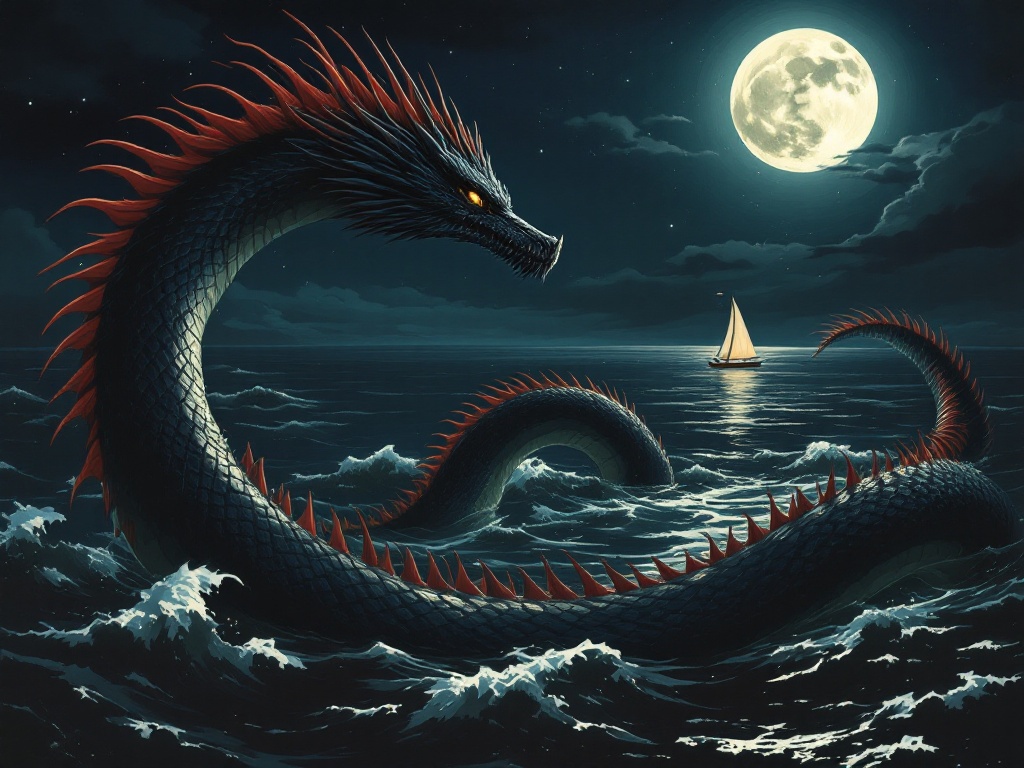
The story told aboard JADA — passed from captain to captain the way the things that must not be forgotten get passed — is that the sea already knew her name before she left the yard.
The name divides cleanly at its midpoint, each half a grammar from a different ocean.
Ryūgū — written 竜宮 or 龍宮, Dragon Palace — is the submarine kingdom of Japanese cosmology, ruled by Ryūjin, the Dragon King of the Sea, who holds the tides with the Kanju and Manju tide jewels and receives the homage of every creature of the deep. The oarfish, Regalecus glesne, carries a specific epithet in Edo-period ichthyological tradition: ryūgū no tsukai, 竜宮の使い — messenger from the Dragon Palace. When a true oarfish surfaces — ribbon-bodied, twenty feet long or forty, its crimson dorsal crest erect against the sky — it is understood to be a dispatch from the seafloor throne. A herald. A warning. A letter of introduction from the deep.
This dragon wears that form entirely: an oarfish-jiaolong plan — ribbon body, crimson crest, crocodilian jaw, no wings, no fire. Only depth. Only patience. Only the silhouette of something that rose from below to deliver news.
Meilichios — the second half — is Greek, an epithet of Zeus meaning the gentle one, the propitiated one, the honey-sweet. In ancient Athens, Zeus Meilichios was worshipped not as the Olympian thunderer but as a great serpent of the chthonic underworld, approached in the month of Anthesterion with honey cakes, libations, and small coins cast into the earth. He was the god of underground powers made patient through right offering. A deity who hunted became, through devotion rightly given, a deity who kept.
Together the name is a description: the messenger from the Dragon Palace who became gentle through right payment. The herald who was answered correctly and chose to stay.
In 1938, Stephens Brothers Shipyard in Stockton, California, laid JADA's keel and stepped her mast. When the mast was placed, a coin went beneath it — as had been done on every wooden ship built at that yard, as had been done on wooden ships for centuries before. Not a superstition, exactly. A payment. An acknowledgment that crossing the water is a transaction, and that something vast and patient holds the ledger.
The story told aboard JADA holds that on her first passage south from Stockton toward the open Pacific, somewhere in the passage from the Delta to the sea, the water rose in a way that had no weather behind it. No squall, no swell-pattern, no atmospheric cause that any of the crew could name. A single enormous wave — or what felt like one in the dark, towering and specific — assembled itself from an otherwise flat surface and moved toward the hull with the deliberateness of something that had decided.
The crew held. The hull held. And in the deep trough that followed, something immense turned to track the boat's course. Not threatening, the story says. Cataloguing. Deciding whether the ship was worth the attention of the deep.
The ledger-keeper had found a new entry. The question was how it would be answered.
She did not fight him. That is the essential fact.
The maritime tradition of placing a coin beneath the mast step is ancient and documented across cultures and centuries. Homer's crews buried silver at the keel; Roman shipwrights sealed coins between hull timbers at laying; English and American builders maintained the practice well into the twentieth century. The coin was never simply a token of fortune. It was understood as payment — an acknowledgment that the vessel enters a domain not her own, and that something is owed to whatever holds the ledger of the sea.
The queen who launched JADA understood the nature of that payment more precisely than most captains do. She did not offer a coin found in a pocket or minted for ceremony. She struck a coin from her own gold crown — the crown she could have kept, could have refused to give, and chose not to. That is the distinction the story insists upon: she was powerful enough to refuse, and she paid anyway. The first payment the sea had ever been offered by one who was under no compulsion to give it.
Hunger, when met with genuine dignity rather than submission or conquest, changes its nature. What had been the wave that nearly broke the hull became the force that bends every wave away from it. Ryūgū Meilichios, whose body was that first impossible swell, accepted the coin and accepted the compact. The debt became protection. The sea bowed. The ledger closed on the wave-side and opened on the guardian-side, and has not closed since.
Every crew member who has sailed JADA long enough has felt it: a moment in crossing water that should be rough when the chop simply flattens. Not subsides. Flattens — as though something beneath the hull pressed a hand against the underside of the ocean and smoothed it.
The story holds that Ryūgū Meilichios exhales once per crossing. The exhale does not move the air. It moves the water — from below, pressing glass across the surface between JADA's bow and wherever she is bound. He chooses the swells she rides. He parts the sea not in front of her bow but beneath her keel, so that she does not push through the water but is carried by it, lifted on each chosen swell and lowered gently into the trough the next has already prepared.
Nothing beneath the surface touches a guarded vessel without his permission.
Guests who have sat at JADA's stern in open bay describe independently the same sensation: the water seems to organize itself around the hull. The feeling is not of stillness but of being held — of the sea deciding, for the duration of the crossing, to treat the ship as a part of itself rather than an intruder upon it. That is his gift. The answer to drowning seas. The compact fulfilled, crossing by crossing, ever since the wave night of 1938.
The story of Ryūgū Meilichios is invented. The traditions it draws from are not. Each element of his name, form, and compact has a documented root in genuine scholarship.
The ryūgū no tsukai designation for Regalecus glesne appears in Edo-period natural history. The creature's association with seismic warning and royal undersea dispatch is a persistent thread in Japanese maritime culture, treated in Okada, Fishes of Japan (1938), and its European parallel — the "King of Herrings" — appears in Aldrovandi, De Piscibus (1638). When oarfish beached on the Japanese coast before the 2011 Tōhoku earthquake, the ancient identification of the creature as a messenger from the deep regained widespread attention.
Farnell, The Cults of the Greek States, vol. I (Oxford, 1896), pp. 61–66; Nilsson, Greek Popular Religion (Columbia University Press, 1940), pp. 75–81. The serpent-form of Zeus Meilichios was depicted on votive reliefs at the sanctuary near the Ilissos River — coiled, monumental, receiving household devotion. The Anthesteria propitiation rituals, honey cakes offered to the chthonic serpent, are the direct root of the name's second half.
Gesell, Coins and Ships in Ancient Mediterranean Religion (1985); Greenhill, Archaeology of the Boat (Wesleyan University Press, 1976), pp. 212–214. The practice of sealing a coin beneath the mast step continued at British and American yards building wooden vessels through at least the mid-twentieth century. Whether Stephens Brothers in Stockton observed it in 1938 is not documented. The coin is in the story. The story is in the ship.
Ryūgū Meilichios is the eldest of six. They were not summoned together. Each found JADA in a different era, through a different compact, drawn from a different tradition of the world's dragon knowledge. They share one allegiance and no hierarchy except age — and Meilichios is oldest. Together they are the Dragon Bodyguards of JADA.
The ship herself: queenofsandiego.com